
Running out of space – it’s just one of those things when it comes to running a business.
At this point, you have options if you want a meaningful upgrade: Do you build outwards or build upwards?
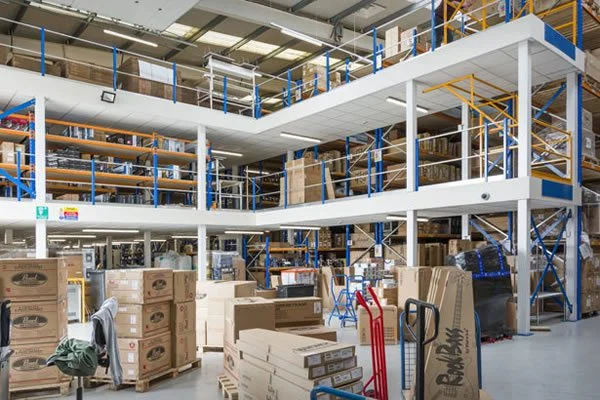
A traditional extension adds new floor area to the building. A mezzanine floor uses the vertical space you’re already paying for.
Both have their place, but for most businesses working within an existing building footprint, the differences in cost, speed, and flexibility are colossal. Let’s compare.
Cost Per Square Metre
According to industry cost data, a typical freestanding commercial mezzanine floor costs between £300 and £600 per square metre, fully installed – including steelwork, decking, staircases, handrails, and building-regulations compliance. For a basic storage mezzanine, the structure alone can come in at £75 to £150 per square metre.
A traditional single-storey commercial extension, by comparison, starts at around £1,500 per square metre and can reach £2,500 or more depending on specification, groundworks, and location. That’s roughly three to five times the cost of a mezzanine for the same usable floor area.
The extension also comes with additional costs that mezzanine floors typically avoid:
● Groundworks and foundations
● Planning application fees and architect drawings
● Extended build programmes with associated project management
● Potential business rates reassessment on the enlarged building
So this round number 1 and it clearly goes to mezzanine floors.
Installation Speed and Disruption
A mezzanine floor can usually be designed, manufactured, and installed within a few weeks.
Many installations are completed in days once everything is delivered and ready to go, and in most cases, installation itself is relatively disruption-free – depending on the site.
An extension is a different prospect altogether. Between planning approval, groundworks, construction, and fit-out, a typical commercial extension runs to several months. The building work itself often requires partial closure or disruption to the areas adjacent to the build (which is also a permit issue in many cases).
Planning Permission and Building Regulations
Mezzanine flooring does not always require planning permission because it doesn’t alter the building’s external appearance or footprint.
It does however require building regulations approval, for example, under Part A (structural safety) and Part B (fire safety), but a reputable installer manages that process as part of the project.
An extension almost always requires a full planning application, plus compliance with the full suite of building regulations – structure, fire, energy performance, ventilation, drainage, and access.
Flexibility and Future Use
A mezzanine is a freestanding steel structure bolted together on site. If the business moves, or the space needs to change, the mezzanine can be modified, extended, or dismantled and relocated.
An extension is permanent. Once it’s built, it’s part of the building. That’s fine if you own the freehold and your space needs are settled, but less appealing if you’re on a lease or expect the operation to change over time.
When an Extension Is the Better Option
Mezzanine floors aren’t the answer to everything. An extension makes more sense when:
● The building doesn’t have sufficient clear height to accommodate a mezzanine with usable headroom on both levels
● You need ground-floor space specifically – for vehicle access, heavy machinery, or loading
● The site has room to expand outwards, and the business case supports the higher investment
● You own the freehold and want to increase the building’s long-term value
Talk to Spaceway
We’ve been designing and installing mezzanine floors for nearly five decades, across offices, warehouses, factories, retail units, and schools.
If you’re weighing up your options, start your project with a free site survey. We’ll assess the building, talk through what you need the space for, and come back with a design and quote at no cost.
Frequently Asked Questions
Do I need planning permission for a mezzanine floor?
In most cases, no. Because a mezzanine doesn’t change the building’s external footprint or appearance, planning permission isn’t usually required. Building regulations approval is needed for structural and fire safety compliance, and we handle that as part of every project.
How long does a mezzanine floor take to install?
It depends on size and complexity, but most commercial mezzanine installations are completed within a few weeks from survey to handover. The on-site installation itself often takes just a few days.
Can I put offices on a mezzanine floor?
Yes – office mezzanines are one of the most common configurations we install. The mezzanine supports partitioning, lighting, power, data, heating, and ventilation, giving you a fully serviced workspace above the operational floor.
Will a mezzanine floor affect my business rates?
It can do. Adding a mezzanine increases the usable floor area of the building, which may trigger a reassessment by the Valuation Office Agency. That said, the increase is typically modest compared to the cost of relocating or extending, and the additional space usually generates enough value to offset it.
Can a mezzanine floor be removed or relocated?
Yes. Mezzanine floors are freestanding steel structures that are bolted together, not welded or permanently fixed to the building. They can be modified, extended, or dismantled and moved to a new premises if the business relocates.