
Any commercial fit-out or commercial refurbishment in England is governed by the Building Regulations 2010, enforced through local authority building control or an approved inspector.
The regulations cover everything from structural safety to electric vehicle charging, and they apply to new builds, extensions, alterations, and changes of use.
Not every part applies to every project, but knowing what’s out there avoids hiccups and friction.
Here’s a full overview of the building codes for commercial buildings and what they mean for your fit-out.
The Full List of Approved Documents
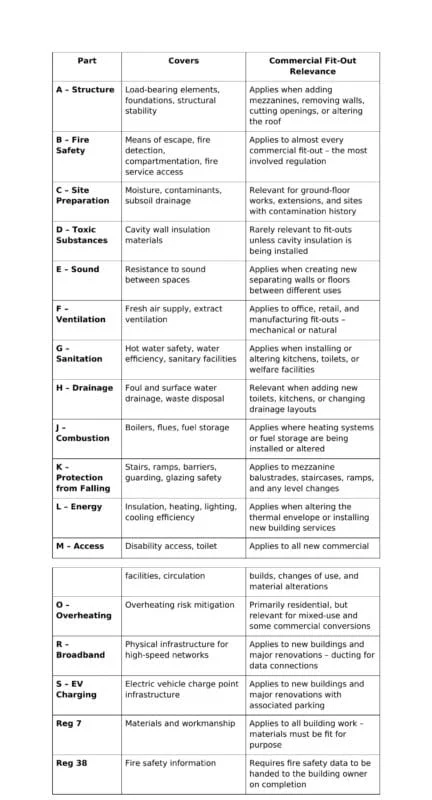
Each part of the building regulations has an Approved Document that sets out practical guidance on how to comply. The table below covers every part and flags how it typically applies to a commercial fit-out.
The Most Common and Deepest Regulations
The following three parts tend to drive the biggest decisions in a commercial fit-out:
Part B – Fire Safety
For a commercial building regulations UK compliance check, the key areas are travel distances to fire exits, fire compartmentation between zones, detection and alarm systems, emergency lighting, and fire resistance ratings for structural elements.
A change of use – warehouse to office, for example – can reset the fire strategy entirely, and there’s understandably no room for flexibility.
Part A – Structure
Any work that affects load-bearing elements needs structural calculations from a qualified engineer, submitted to building control before work starts.
Adding a mezzanine, removing walls, or cutting new openings all fall under Part A.
Part M – Access
Part M covers level access at entrances, accessible toilets, corridor and door widths, and lift access to upper floors, including mezzanines.
These need to be designed into the layout from the start – they’re difficult and expensive to retrofit.
Which Regulations Apply to Common Projects
The applicable regulations depend on the scope of the work. Here are a few examples per project:
- Office refurbishment: Parts B (fire), F (ventilation), L (energy), M (access), and G (sanitation) if toilets or kitchens are being altered
- Warehouse or industrial fit-out: Parts A (structure), B (fire), F (ventilation), K (protection from falling), and L (energy).
- Adding an upper floor or mezzanine: Parts A (structure), B (fire), K (falling), M (access), and potentially L and F if the new level is occupied.
- Change of use: Can reset requirements across the board. Converting a warehouse to office space or industrial space to retail space often triggers a full compliance review.
- Extension: Full planning permission plus Parts A, B, C (site preparation), L, M, and usually F, G, and H (drainage).
How Spaceway Manages Building Regulations
Building regulations are a real maze – but you don’t need to figure it out on your own.
For every commercial refurbishment and fit-out we deliver, we can help manage the regulatory side of the project. That includes:
- Identifying which approved documents apply to your specific scope of work
- Commissioning structural calculations and fire strategy reports, where needed
- Submitting building control applications and liaising with inspectors throughout the build
- Coordinating access, ventilation, and energy requirements into the design from day one
- Securing final sign-off and completion certificates on handover
Start your project with a free site survey, and we’ll map out what’s required before the design work begins.