
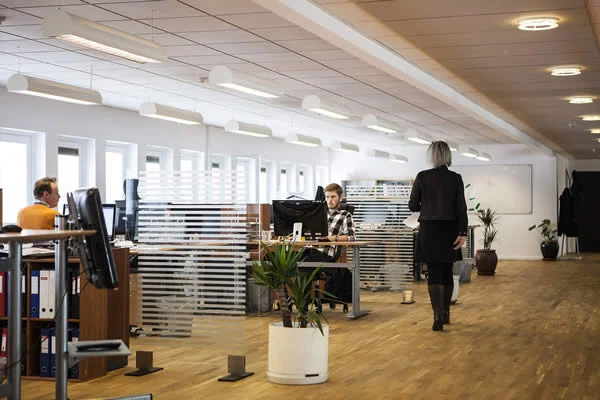
There once was a time when the typical office space was a rather uninspired place to be. Walk in, and you’d find row after row of cookie-cutter workstations, a manager’s office in one corner and a kitchen in the other, typically wrapped up with bland, uninspired decor.
Sure, it wasn’t exactly exciting, but back then offices were seen as little more than a place for workers to clock in, keep busy, and clock out again.
Then along came a whole new generation of modern companies who quickly set about changing the way we think about work in the 21st century.
Placing a greater emphasis on creativity and innovation, such next-generation firms have challenged the very definition of office culture and, as a consequence, redefined the very way we think about office design.
Here at Spaceway, we’ve been proud to work with countless startups and contemporary companies, helping them create the optimum working environment for today’s workforce.
In doing so, we’ve observed a couple of key trends that help companies to get the best from their teams. Here, we look at four such trends that we envision changing the modern workplace forever more.
1: Catering for Different Styles of Working
Back in the day, there was typically only one way of working in an office environment:
Spend most of your day hacking away in solitude at a workstation, head into a nondescript meeting room for an hour of unproductive chatter, then head back to the desk.
Today, more and more companies are seeing the benefits of a more relaxed, informal approach to collaboration, creating fresh, inspiring spaces that encourage workers to come together and co-create.
Typically, such spaces take the form of dedicated ‘break-out’ areas with comfortable chairs or sofas, contemporary decor and plenty of space.
Still, the most forward-thinking enterprises understand that not everybody works best in a collaborative environment, and that sometimes, bunkering down in fortress of solitude really is the best approach, especially when deadlines draw ever closer.
For those workers, some offices are starting to incorporate dedicated ‘quiet spaces,’ with furnishings, decor and a layout which inspires a sense of quiet, calm and concentration.
2: Promoting Movement
It’s often said these days that sitting is the new smoking, meaning that all those long-hours chained to a desk is having a detrimental impact on the health of our nation’s workforce.
Sure, providing the opportunity to move into break out areas is helpful, but it isn’t the only way that modern organisations are encouraging their teams to get up and move around.
Over the last few years in particular, we’ve worked on office design projects that make regular movement a necessity. That could be by placing printers and other essentials a distance away from workstations, building those break-out areas on a separate floor to the main office space, or even investing in stand-to-sit desks which give desk workers the chance to frequently change their position throughout the day.
3: An Emphasis on Quality Downtime
Speaking of health and well-being, did you know that the typical UK worker spends an average of 84,171 hours at work over the course of their career?
That’s not to mention the 14,053 one survey suggests those same workers spend commuting back and forth throughout their working life.
In other words, we spend an awful lot of time in the office, making it vitally important for our well-being that we take regular breaks and enjoy some quality downtime in between long stints at our desks.
It’s for this reason that we’re seeing more and more companies invest just as much in recreation and quality break areas as they do on the central hub of their operations.
Again, comfortable chairs and soft furnishings play an integral part here, as does natural lighting and optional indoor plants, both of which have been known to promote positive mental well-being.
We’re also seeing games, entertainment and other forms of recreation becoming increasingly common, allowing employees the chance to completely unwind before returning to work feeling refreshed and ready to create.
4: A Fusion of Old and New
Of course, all this talk of innovation and forward-thinking doesn’t necessarily mean that today’s businesses are leaving the past behind forever.
While new-build office buildings certainly have a lot to offer, there has been a huge trend in recent years of companies moving into older buildings and repurposing them to suit their needs.
Empty warehouses, factories, and an array of classic buildings have been transformed into beautiful workspaces which combine the aesthetic appeal of older architecture with contemporary features and furnishings.
Moving forward, we fully expect even more companies to embrace design concepts which create the perfect fusion of old and new.
Looking to bring your office into the 21st century? Ready to redesign your space to promote well-being among your workforce? Call us today on 0800 085 1022 to find out more about how Spaceway can help you transform your workplace.