
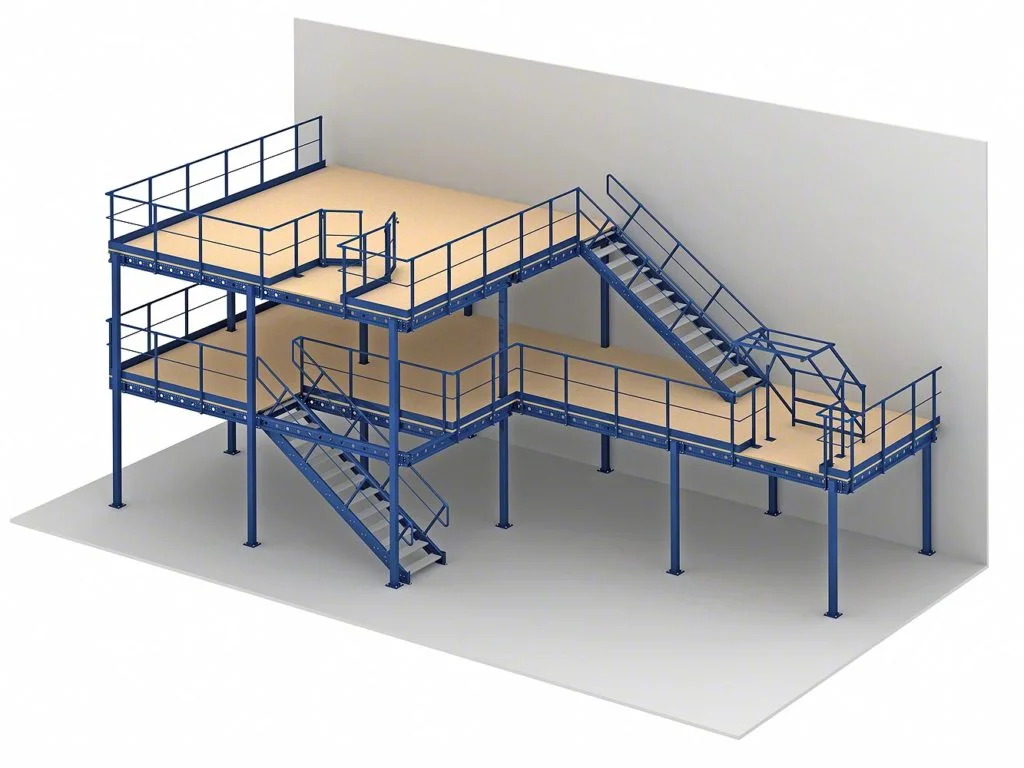
As mezzanine floor specialists, we continuously want to broadcast the benefits of mezzanine flooring to our clients as a way to transform an office, warehouse or production space in a unique way.


Although we know how achievable this is, a lot of our clients approach us without realising its cost-effectiveness and actually how straightforward it is to do. A mezzanine floor is a structure that is commonly fitted into warehouse buildings and commercial buildings to create extra space which can be used for offices, storage or production. For our first story, we have selected some frequently asked questions from previous clients, answered by Spaceway’s Director, Dominic O’Brien, for those yet to discover the magnificence of mezzanine flooring and why it is such a great solution for somewhere with limited space.
First of all, we asked Dominic one of the most popular questions which are whether or not people actually need a mezzanine floor. Dominic’s response was simple; if someone has run out of space at their property, need to fit more people in, need more storage or office space, mezzanine floors are a great solution; especially if you have a lot of roof space.
This is all well and good but what about actually installing the floor?
In the past, a lot of people have asked whether or not we can install a mezzanine floor over a previous floor surface and guess what, the answer is yes. A mezzanine floor is usually fixed to a concrete surface by simple floor anchors which are bolted through a square base plate, so it is very straightforward to do. It can be installed quickly and easily and can be removed in the future, if necessary.
 Another question often asked is whether or not our clients can make changes to an original mezzanine design. During the drawing stage, changes can be made to an original design if clients change their mind in the process. Once you’re completely happy with the design and it has been approved, then it will go into manufacturing. Obviously, designs cannot be changed after the manufacturing process begins but Spaceway will work with you every step of the way to ensure that you are happy with the design in the first place.
Expanding from this, there are several designs to choose from for a mezzanine floor, another one of our frequently asked questions. The standard material for a mezzanine floor is a 38mm thick chipboard but metal durbar plate or plywood can be installed on top of this for heavy use and there can be a softer matting on top of this again, particularly in warehouses where people can be on their feet a lot of the time.
All of the steelwork will come to site pre-painted and that can be any colour you like but typically colours are light grey, dark grey and royal blue as standard, to keep the costs down. In terms of finishes, other than the standard paint finishes, the decking comes as a 38mm thick chipboard which can be used straight away as a finished surface or you can coat that with a floor covering. Handrail posts and staircases can be painted to match the steelwork too.
So, how much should a mezzanine floor cost? Dominic states that there are additional costs that clients need to be aware of: levels of fire protection for the floor, means of escape and staircase evaluation and possible air conditioning for the floor in the summer. Every space is different though and will have a unique cost as a result. In July, Spaceway launched an online mezzanine calculator and flexible finance leasing scheme for businesses seeking to expand their office and storage workspace. The calculator is simple to use, enabling users to input their specific type of mezzanine workspace (office, storage or both), by area in metres, as well as the number of staircases, safety rails and dedicated loading space if required.
The user will then view a calculation of the estimated costs and a visual CAD image of a mezzanine floor they had specified.
You can view and use the calculator by clicking here.
Look out for our feature in Contract Flooring Journal where Dominic O’Brien will answer even more questions from our clients.